
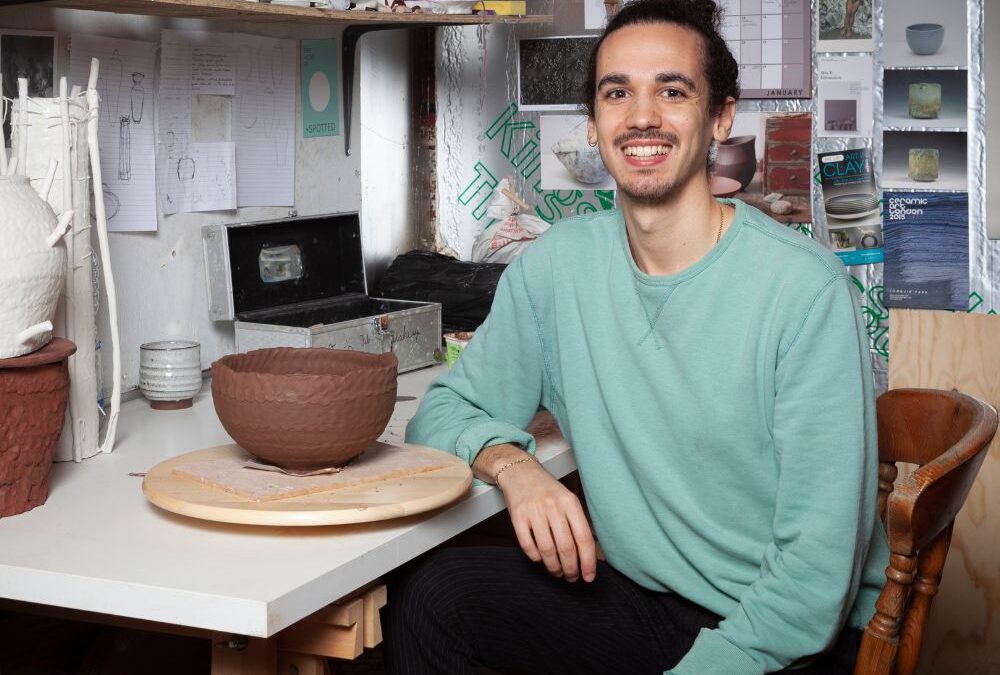
Can you start by introducing yourself and sharing an overview of your artistic practice?
I’m a ceramic artist whose work explores themes of identity, memory, and belonging—using my practice as a way to navigate and make sense of my place in the world. My approach is grounded in material investigation, with clay acting as a vessel for personal and autobiographical expression. While coiling is my primary method, my process is intuitive rather than fixed; each piece becomes a kind of experiment, a way to push ideas forward and test new possibilities.
Having a history of migration, there is a feeling of belonging and not belonging simultaneously, parallel to the idea that my work sits in the space between tradition and breaking-with-tradition, functionality and non-functionality, craftsmanship and idea-based art. This space in-between is where my identity is formed.
What led you to explore ceramics? Was there a specific moment or inspiration that sparked your interest in working with clay?
I was first introduced to clay in school after moving from Madeira to the UK in 2008. Although I’d likely come across clay back in Madeira, I hadn’t engaged with it creatively until secondary school, where ceramics was offered as a subject. Something about the material just clicked—perhaps it was the ease I felt with it compared to more traditional academic subjects, which made me lean into it, somewhat naively at first.
I went on to study ceramics at GCSE and then A-level—something I now recognise as incredibly fortunate, given how rare those courses have become. Alongside ceramics, I also took textiles and fine art, and with the support of some very encouraging tutors, I pursued a foundation course at Brighton and Hove City College in 2013. That’s where my connection to ceramics really deepened. I began assisting ceramicist Anna Barlow in her studio, which gave me my first glimpse into the professional world of making.
As cliché as it might sound, I sometimes feel like clay chose me. One step led to another, and before I knew it, I’d enrolled in the ceramics degree at Cardiff Met. And here I am—still working with clay, still exploring where it can take me.
How central is wood and alternative firing to your practice, and how does it shape your work?
Before the firing at Oxford Anagama kilns with the County Hall Pottery team, I only did 3 wood firings. The first one was an introduction to build and fire a fast wood kiln at the same site in Oxford, which gave me some sort of confidence to build my own kiln and fired it twice in Madeira for some work to be exhibited at my first solo show, Cacúlo at MUDAS (2023).
I am far from being a wood firer but can totally see how people can geek out with the technicalities. My knowledge is very basic, yet I keep absorbing more and more as I do more firings. There are incredible results from these sorts of firing and specially from the Anagama kilns as the amount of exposure to the flame transforms the work in a totally different way compared to the fast fired kilns.
I see wood firing as a kind of collaborator in my practice. It brings unpredictability, connection, and narrative to the work. Firing with wood connects deeply to place—especially in works exhibited at Cacúlo, where I used pine wood from my grandparents’ land in Madeira. The firing process isn’t just technical; it’s narrative. It carries the story of the materials, the labour, and the land they come from. Despite its technicality, there is some sort of romance attached to it. I am interested in how the coming together of people firing a big kiln over the period of a few days can add to the final result. I felt incredibly touched and somehow transformed from the experience of firing the kiln with the County Hall Pottery team.
Do you have an interest in the Firing process? Does the firing process affect the shape or material application of your work.
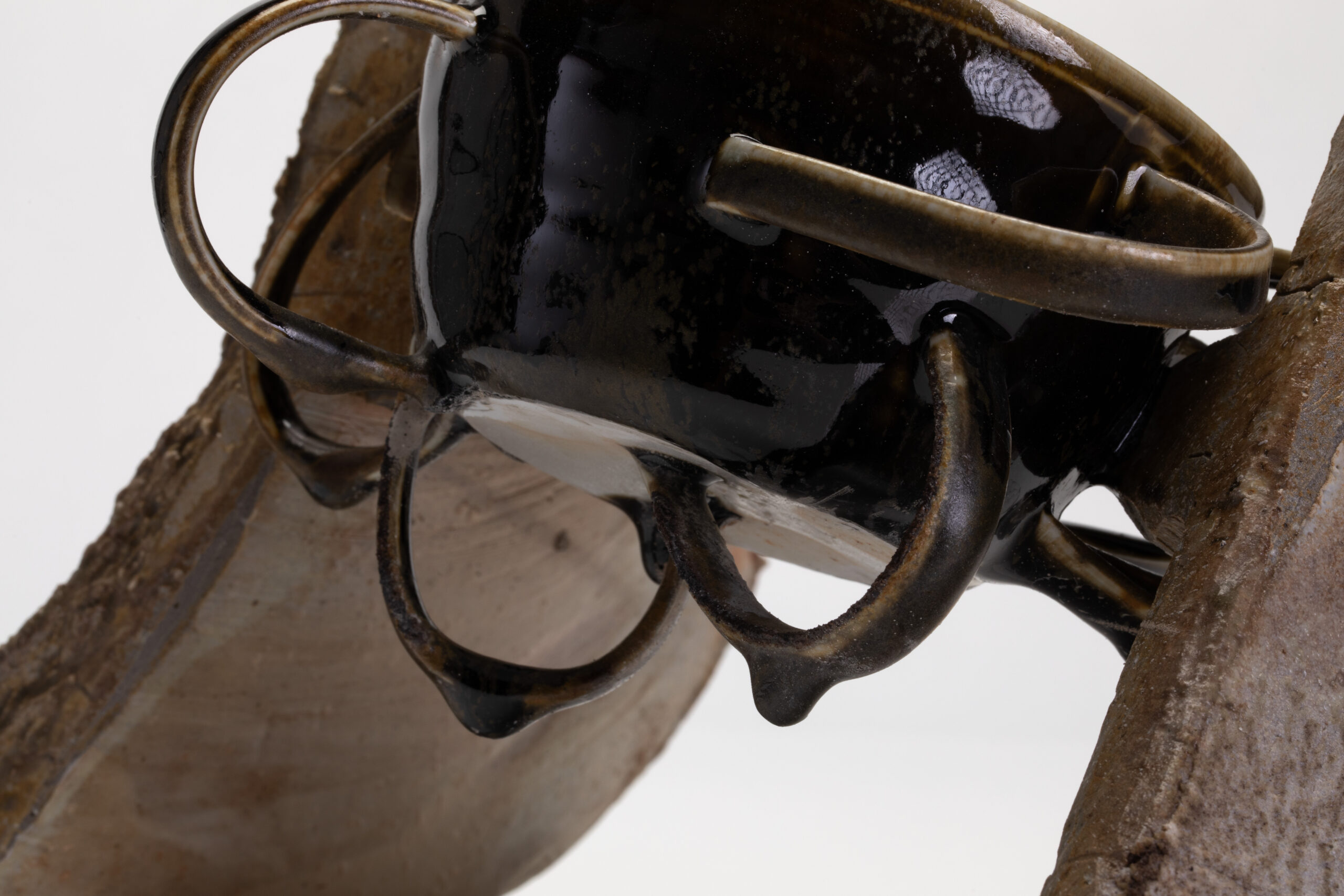
The firing process plays a central role in how I approach form, especially when working with fluxed materials, wild clays, or combustibles. Through ongoing experimentation, I’ve developed a sense of how the kiln might affect each element—what might melt, shimmer, crack, or shift. But even with that knowledge, the outcome often surprises me. Sometimes the work slumps, sometimes it reveals something unexpected. Either way, I see firing as an essential part of the work’s transformation—an unpredictable but necessary phase in its becoming.
Do you lend into the natural uncontrollable aspect of alternative (non electrical) firings or do you design your work to lend into the effects given?
My lack of knowledge when it comes to the effects a wood firing might have on material led me to focus on porcelain but also experimenting with elements like combustibles, and fluxes. I surrendered to the process. There’s a strange kind of freedom in relinquishing control. I might shape a surface knowing how flame might lick it or how ash might settle—but part of the beauty lies in the unpredictability. It’s a dialogue between intention and accident.
I was particularly interested in placing fragile looking work in this harsh environment and the potential it might give.
Where do you typically find inspiration for your art? Are there particular themes or sources that resonate with you
My inspiration often comes from lived experience, objects and material. I’m drawn to objects with history, cultural detritus, fragments of the everyday, the soil and elements of specific landscapes. There’s a strong autobiographical layer in much of my work, and I often use clay as a way to preserve or reimagine memory. Thematically, I’m interested in transformation, impermanence, and the layering of time.
The time you spend producing a piece is so precious. All your lived experience and knowledge is capture through your fingers tips however long you might spend with the work.
Can you walk us through your creative process, from concept to completion?
It’s rarely linear. My head is a little all over the place despite my apparent calm nature. It might start as a doodle, an object, a photo, a test tile, a previous piece or body of work. Ideas emerge from the act of doing. I work mostly by coiling, and often use both terracotta and porcelain, depending on the context of the material. Other materials and fluxes might come into the making stage to add to the idea of narrative or unpredictability. I will use other techniques as well, like throwing and casting but not always in the way they are expected. The work is dried and bisque to 1000C. The work might then be reworked with more clay elements or glazed. I tend to stick to one glaze as it can be quite overwhelming. Not only technically but also how oneself can be reflected through colour. Small elements are slowly emerging through colour but it is a small process for me currently. The work is then taken to a 1240C firing. Other firing will take place if the work needs glaze retouching, decals or gold lustre.
Often, the physical act of making allows me to access thoughts I can’t articulate any other way. Potentially due to the fact that you are focused and thoughts and ideas are constant being analysed in my brain, I somehow struggle to express them verbally. Ideally, I want to believe that the intent of my ideas and thoughts which are perishable and intangible are captured and ever-present physically through the work. I try to give insights to the viewer through context, titles, materials and curation.
Where do you create your work? Could you share a bit about your studio or workspace?
I’m based at Fireworks Clay Studios in Cardiff, a large collective studio where I’ve had a space since 2021. I have been moving through different sized space – I just moved to a slight bigger studio within the premises. It’s an incredible environment, full of expertise and diversity. I have my own electric kiln and test kiln and a few work benches. I attempt to keep things tidy but once its making season I tend to work on more than one piece and things can get a little chaotic. With fired work, I am conscious of scale and the amount that I am putting into the world as the space becomes smaller if not in a show or sold plus environmentally, it’s not sustainable. Also, the way I see my work is that each piece is an experiment and therefore things are not constantly repeated making me less worried about being a production line.
How would you describe the pieces you’ll be exhibiting at County Hall Pottery Gallery? What do you hope viewers take away from them??
The work exhibited at After Ash is quite varied. I have work fired at the Oxford Anagama kiln in May 2025 which in itself is different from one another. Plus, thought to include some other bits.
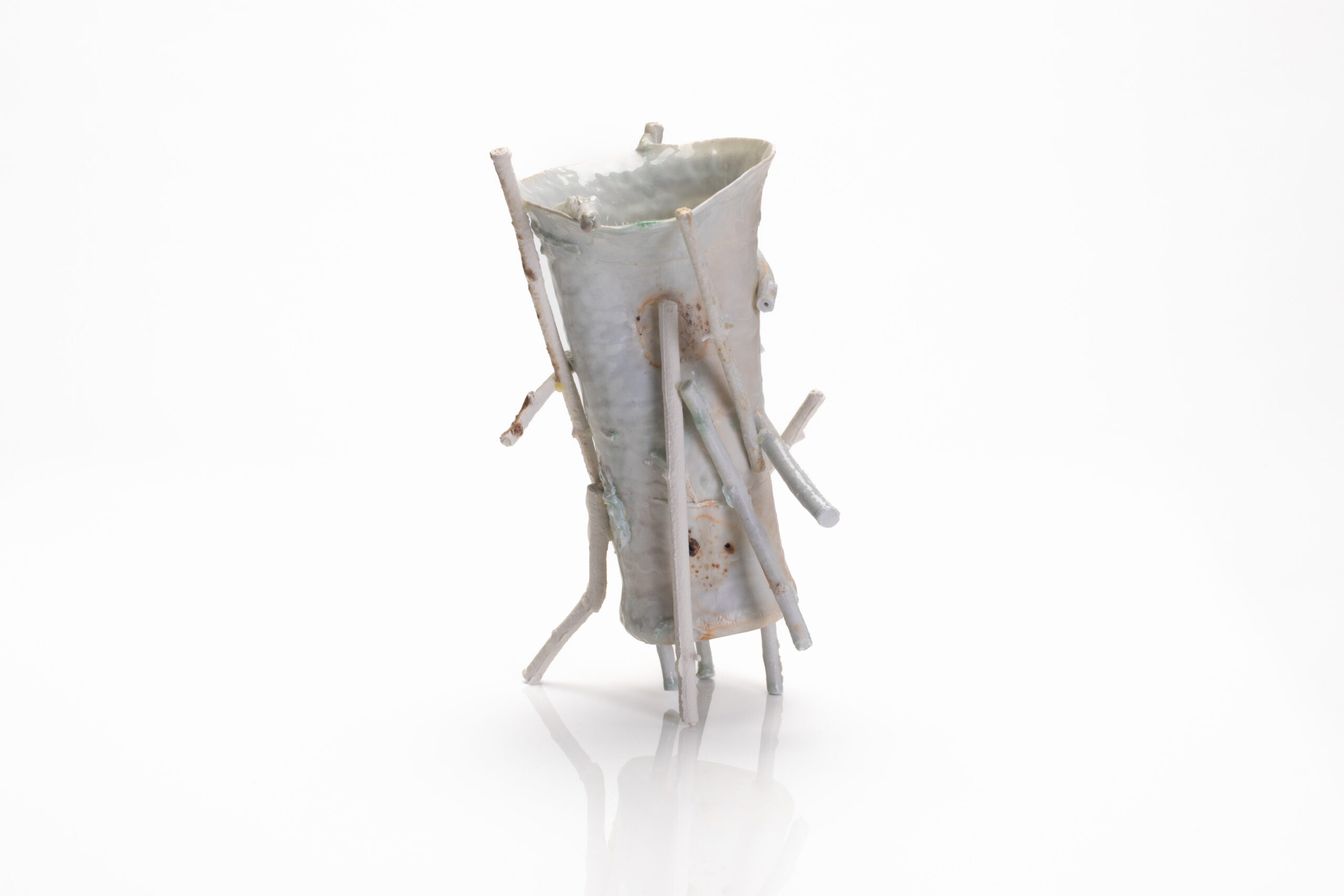
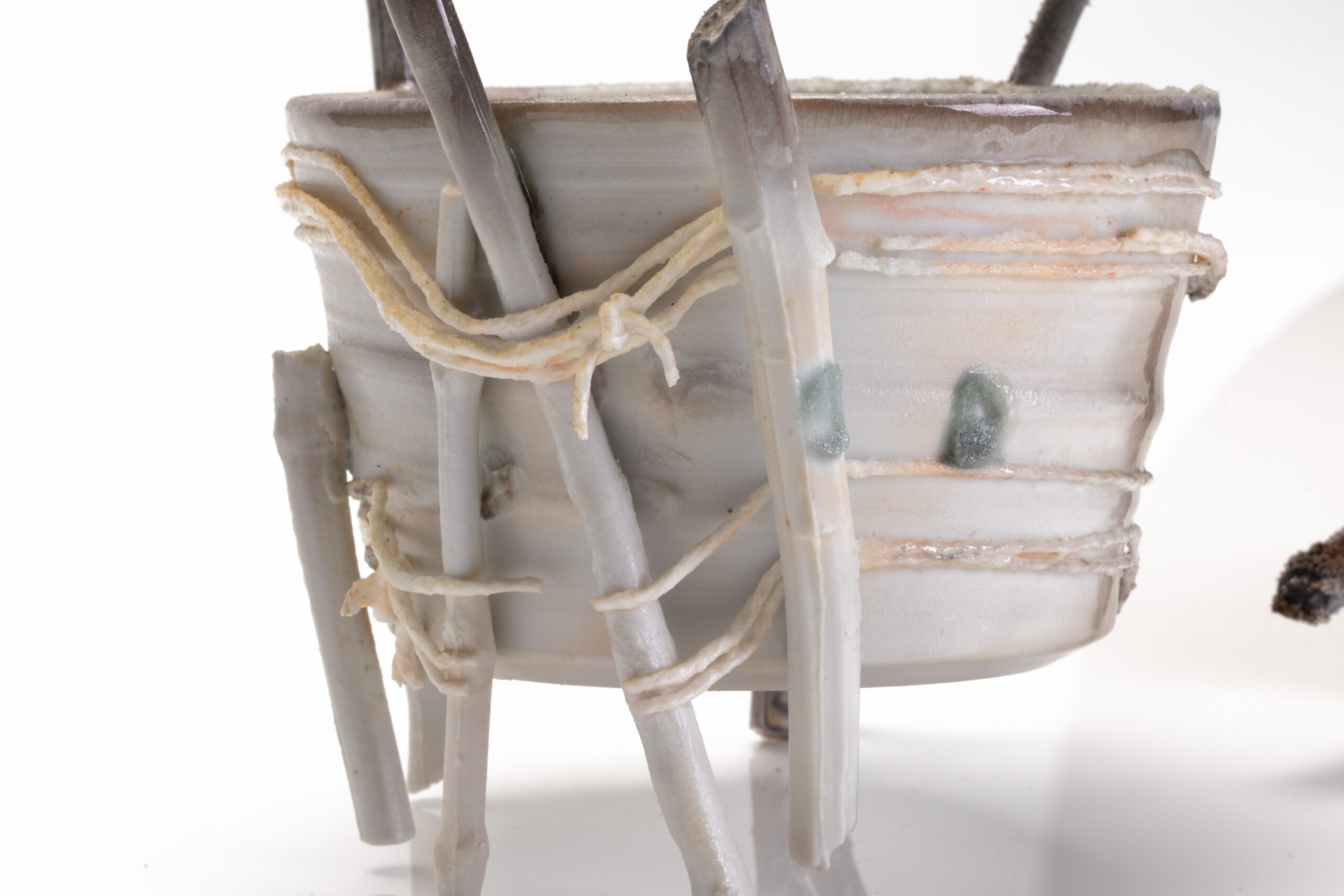
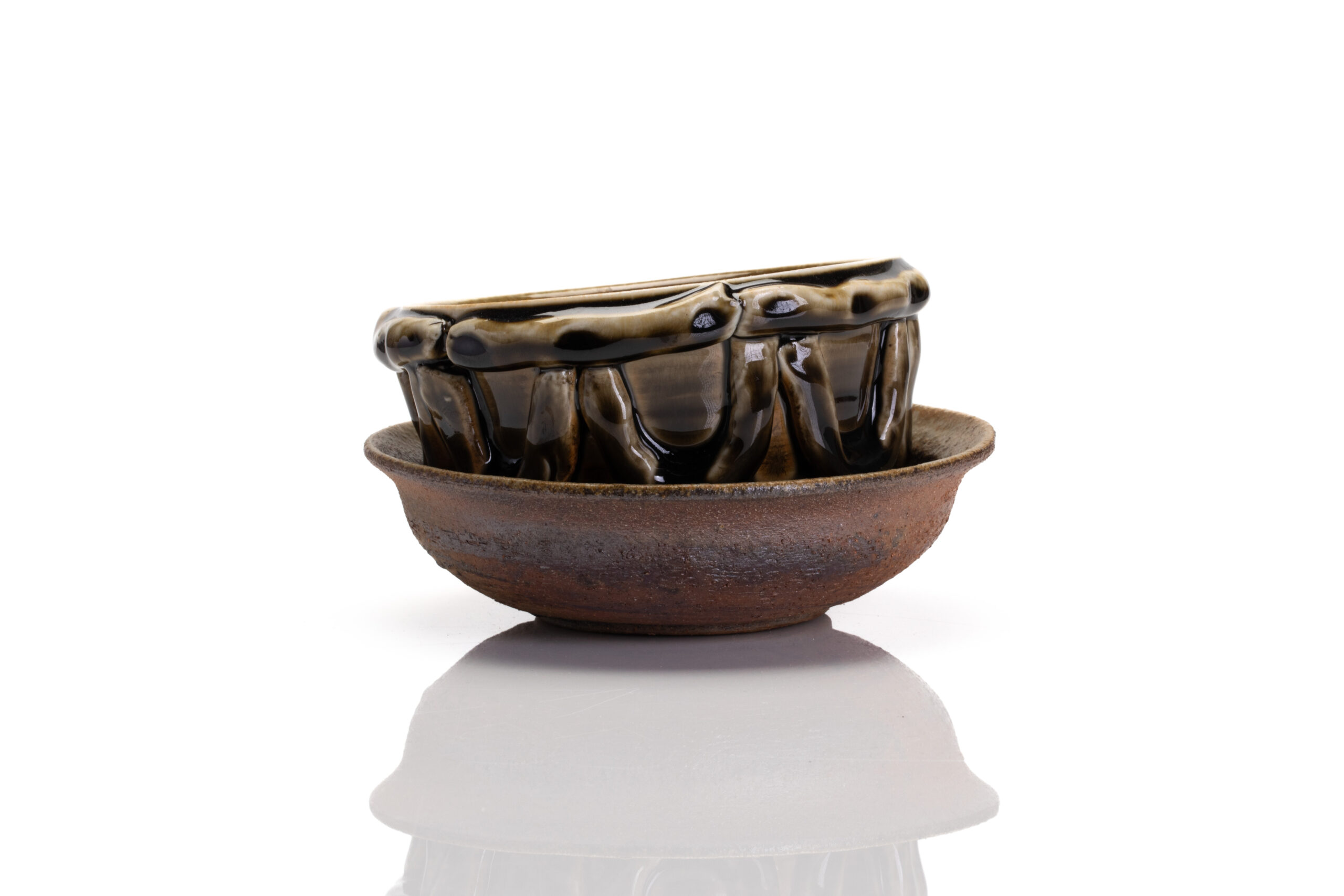
I have made a series of bowls with various degrees of decorations and glazes. Some have twigs attached to them whereas others have pulled handles, coils and words. Despite them looking quite different I like how they have a link with one another. The twigs could be handles and the handles could be twigs. The coils could be words and the words could be a mark. More than anything I tried to see how the different glazes (Ash, Celadon, Tenmoku) would react in the firing and how bare porcelain would react at different spots in the kiln.
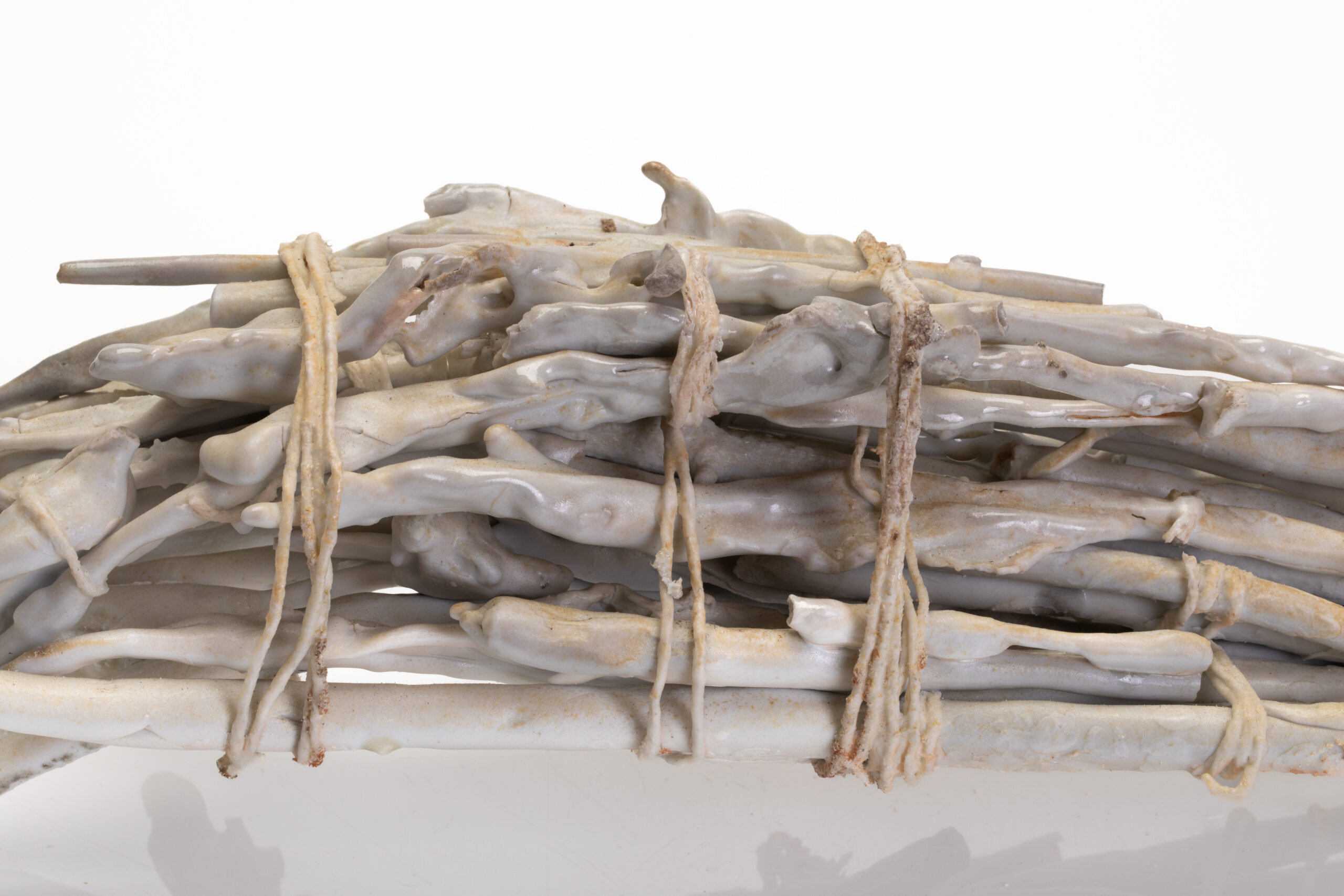
I initially thought about dipping flowers in porcelain and arranging these with other cast and handmade elements to create the twig arrangements. I used porcelain with additions of fluxes and glazes to observe how they would react and fuse together in the wood kiln. One of the pieces didn’t make it to the wood firing so I used the ash from the firebox to glaze the piece and see the result.
Inspired on some other work done before including Altar Vase (2023) and Transposition (2021) I was interested in their fragile nature. They look fragile yet they are ceramic, there is a certain strength to them, but how to they would react to the brute force on the kiln, that’s where my interest was. The elements extending from the vessels also remind me of points of contact, points of change and points of flux.
I had a few things attached to other works which was interesting to include. A reminder that the work placed in the kiln and fired by all of us, actually belongs to all of us.
The extra works include pieces fired in other wood kilns including Hirlwm (2024) fired by Jean Sampson on the Girel3e wood kiln at Mid Wales Arts Centre and Vai uma peça, ou duas? (2023) fired on my own wood kiln in Madeira.
I just want the viewer to see how unserious the whole thing can be but the strong potential. The work is all very experimental and draws from various elements, but this is only a snapshot of ideas, and enough fuel to keep me pushing things further.
Do you have preferred techniques or materials you work with in ceramics? What draws you to these approaches?
I mostly use coiling. I love the slowness of coiling—it becomes meditative, a way to imprint time into the form. I also have adapted the way I coil to be quite structured or less rigid. I am able to merge both porcelain and coiling in a way that despite the work looking at times minimal, it is covered with small details like finger prints and imperfections where coils are being blended together. I like the contrast that I can create by adding different elements to the surfaces either being through material or figuratively. Despite me believing that I am in control, the work and the firing gives back as well. The work shifts, the porcelain remembers how it was treated and once fired, it humbles me.
What are you currently working on? Are there any upcoming projects or exhibitions we should look forward to?
As After Ash goes up, I will be also be installing Cacúlo, as this is its second stop of its tour in the UK at Ruthin Craft Centre. This solo show began in MUDAS – Museu de Arte Contemporânea da Madeira (Portugal, 2023); centred around the interplay between myself, the work, material and place.
This yearning for connectedness made me delve into themes of place, memory and loss – core elements of my migrant experience. I began this project by looking at the integration of local materials and their application to the work – in relation to the use of ceramics within the 600-year history of Madeira. This initial research was a way to look at physical evidence of this history. Materials that ultimately make up the place where I am from, materials that make up who I am.
The tour is a Llantarnam Grange Arts Centre and Ruthin Craft Centre Partnership exhibition funded by Arts Council of Wales Create Funding which is now running between the 5th July and 5th October 2025.
If you find yourself in Miami later this year, you can also see my work at Design Miami with J. Lohmann Gallery.
View the price list for the artwork Toni is displaying and available to purchase in our After Ash exhibition here, and follow Toni on Instagram here!
To take part in a County Hall Pottery exhibition or to speak to the team, please email gallery@countyhallpottery.com.