
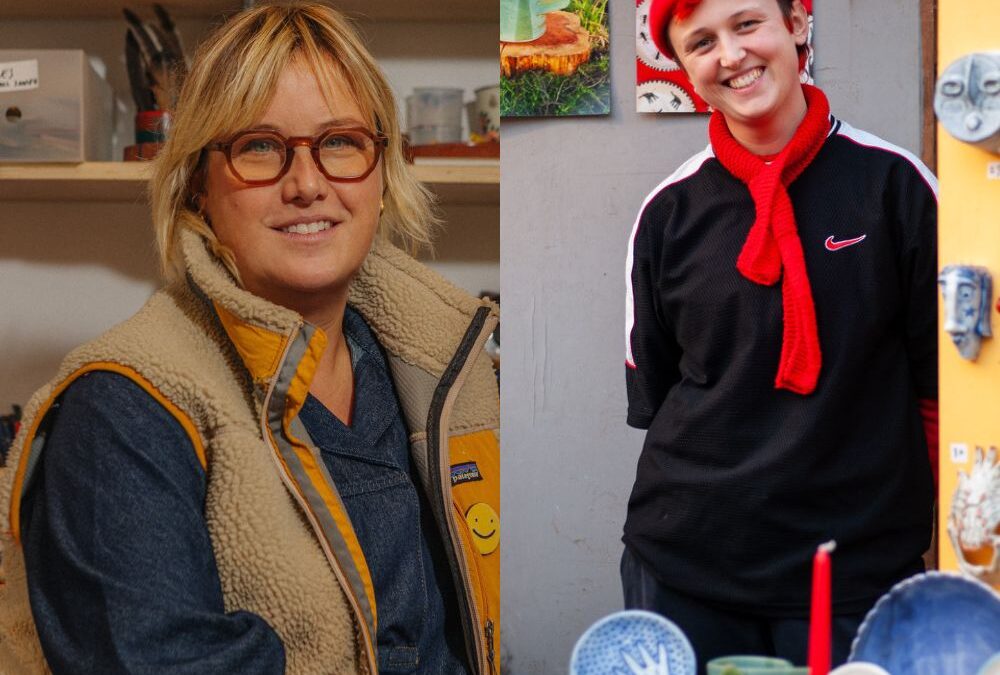
Can you start by introducing yourself and sharing an overview of your artistic practice?
Francesca Anfossi
After training in fine art at Slade School of Art my attention turned to the social aspect of art and craft, with clay emerging as my primary medium. I am inspired by its very nature – a versatile, inclusive and non-hierarchical material.
My ceramic works celebrate functionality and exchange, based on some of our most basic activities: cooking, playing and sharing. My work is eclectic and takes a collaborative and playful approach to craftsmanship.
What led you to explore ceramics? Was there a specific moment or inspiration that sparked your interest in working with clay?
Like many people I used clay as a child in Italy, the material was very familiar to me, however on a trip I made to India some years ago. I was fascinated by the system there of recycling clay teacups: they are fired at very low temperatures, making them so friable that they can easily be turned back into soil when smashed to the ground after use. The soil is then used again to make new teacups. This image really stuck with me, and it guides me in my approach to start Rochester Square: a sort of creative earth cycle from soil (clay) to plants (food) to plates (eating).
Did you receive formal training in ceramics, or did you develop your skills independently?
I did a short course at Working Man College, and after that I developed my skills independently, setting up a communal space surrounding myself with potters every day has improved and taught me a lot very fast
Can you walk us through your creative process, from concept to completion?
My creative process is shaped by the context of each project—the surrounding environment, the people involved, and the thematic framework of the exhibition or commission. I also find inspiration in the materials themselves. As I begin working, ideas naturally evolve through direct engagement with the medium.
My ceramic work explores the rituals of everyday life—cooking, playing, and sharing. A playful sensibility is integral to my process and how I envision my work being experienced by others.
How central is community to your practice, and how does it shape your work?
Since I started working with clay, I realised what an adaptable, inclusive and non-hierarchical process it is. For a start, we use it every day in one of our most basic activities: in the form of tableware for eating. From children’s education to making art, from architectural experimentation to crafts therapy, clay can be both a very humble and a highly sophisticated material. Furthermore, ceramics, like many crafts, is inherently communal: technical progress on an individual level is often obtained through the exchange of practical knowledge with others.
Where do you create your work? Could you share a bit about your studio or workspace?
I make my work in Rochester Square that I co-founded and run since 2017, a dynamic community space and garden in Camden which brings together both internationally exhibiting artists to local potters, emphasising the accessibility of clay as a material open to any level of skills and technique.
We all learn a lot from each other and it’s a very vibrant community of multigenerational people.
How did you both find each other to collaborate with on this project? Have you collaborated before together? Will you again?
Frances Gibson and I work both in the same studio (Rochester Square), which means we regularly see and engage with each other’s work. Our collaboration developed very naturally from this daily interaction and a mutual respect for one another’s practice. Frances is also a key presence at Rochester Square, where she leads workshops and contributes to the creative community in a meaningful way.
I’ve always been drawn to Frances’s distinct sense of humour, which comes through clearly in her ceramic work. I remember seeing her create pieces that resembled game counters, and it immediately sparked the idea of working together. Her strong illustrative skills, imaginative approach, and her experience facilitating playful, hands-on workshops for children made this collaboration feel like a perfect fit.
This is our first project together, and it has already been a positively challenging and rewarding experience. We’ve both learned a great deal through the process, and I’m confident this is just the beginning of more collaborative work to come.
Do you have preferred techniques or materials you work with in ceramics? What draws you to these approaches?
I primarily work with coiling and hand-building techniques. I often use terracotta clay for its warmth and earthy quality, and I often mix slip decoration with wax resist glazing technique to explore surface and texture in a playful, expressive way.
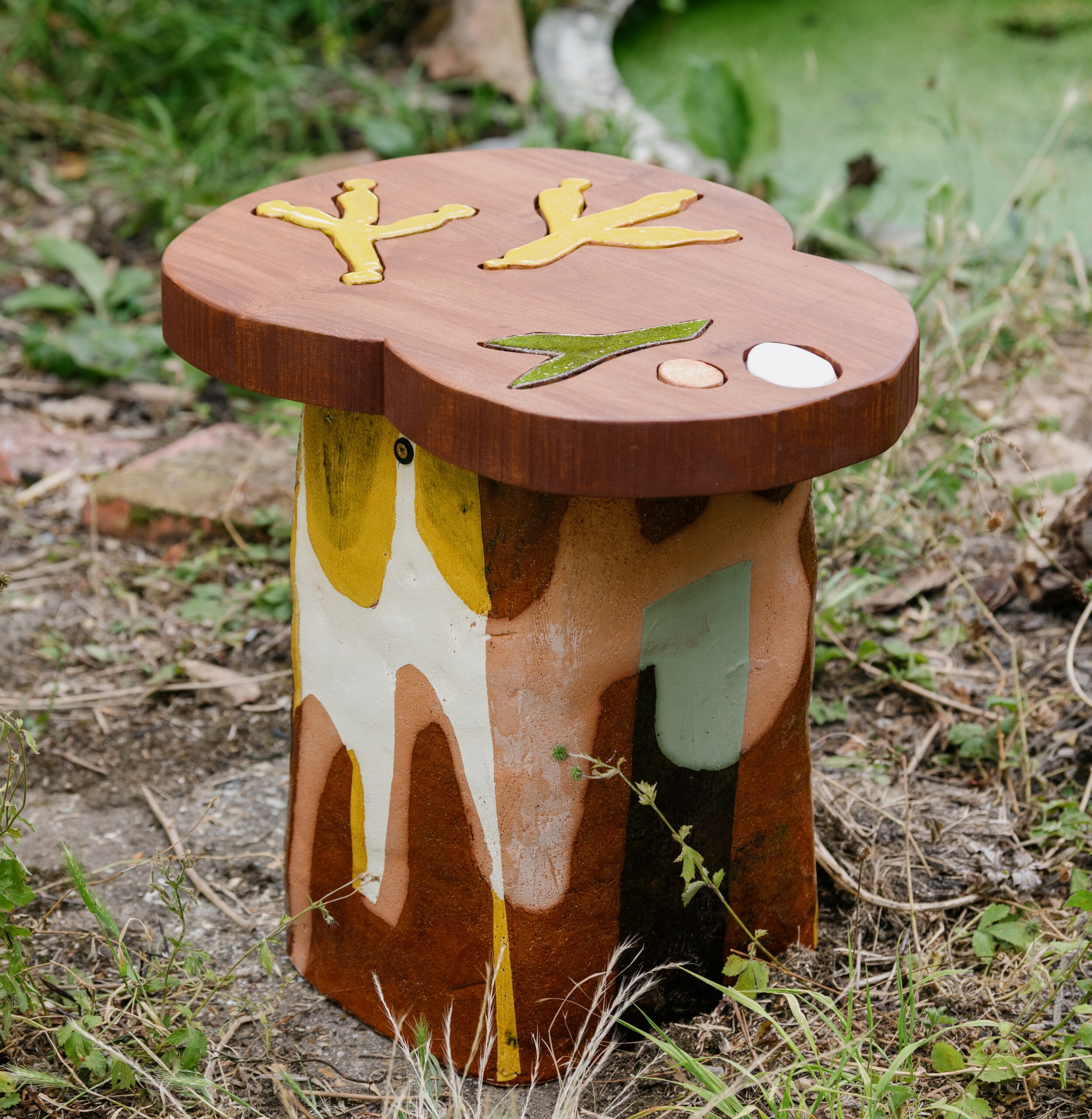
Collage has always been my starting point of making and an inspiration in my practice. This influence has naturally extended into my recent work, where I’ve begun routing ceramic shapes into wooden surfaces to create tables and stools.
How would you describe the pieces you’ll be exhibiting at County Hall Pottery Gallery? What do you hope viewers take away from them? Can you talk about the specific materials and techniques you are using for this exhibition?
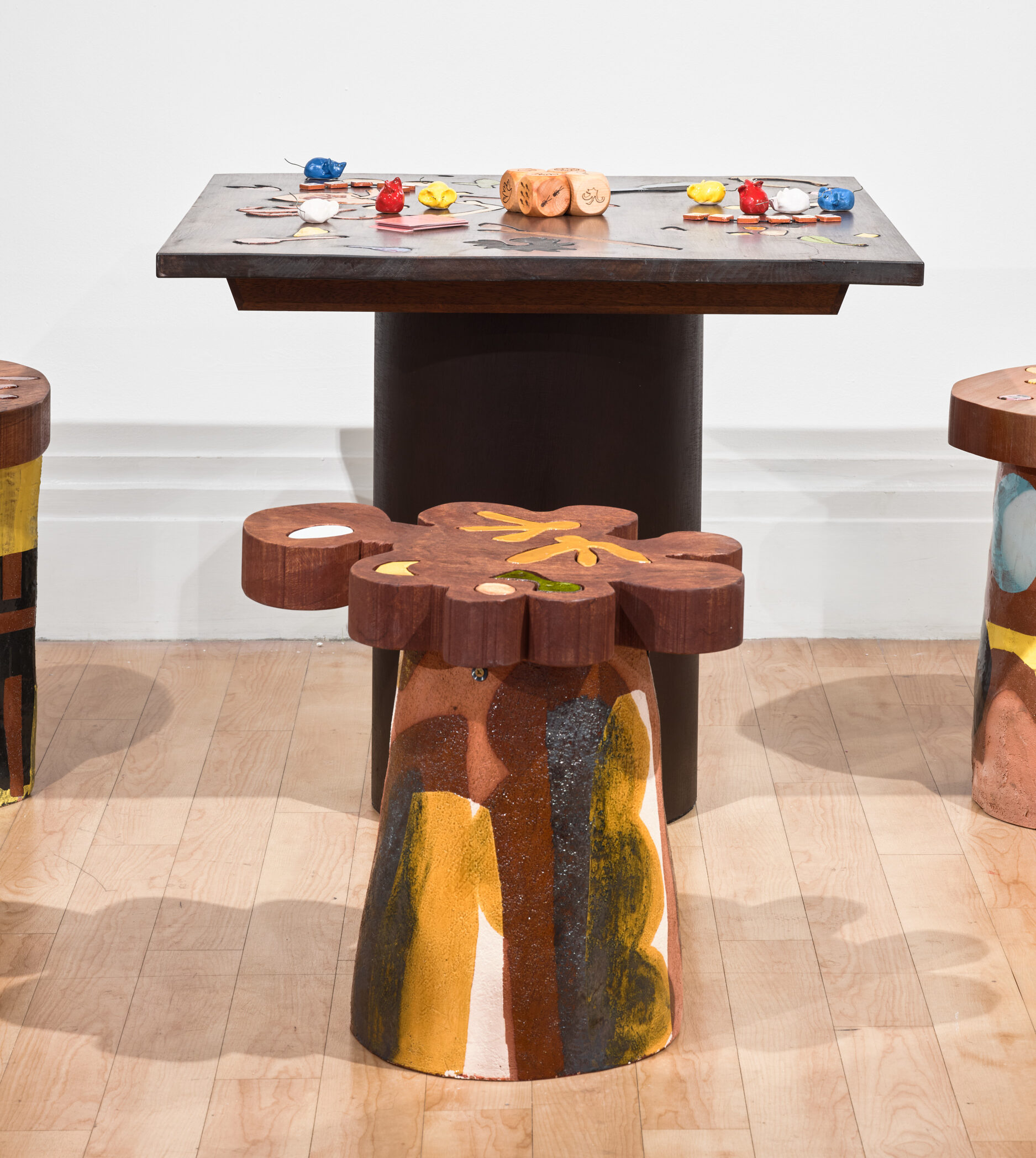
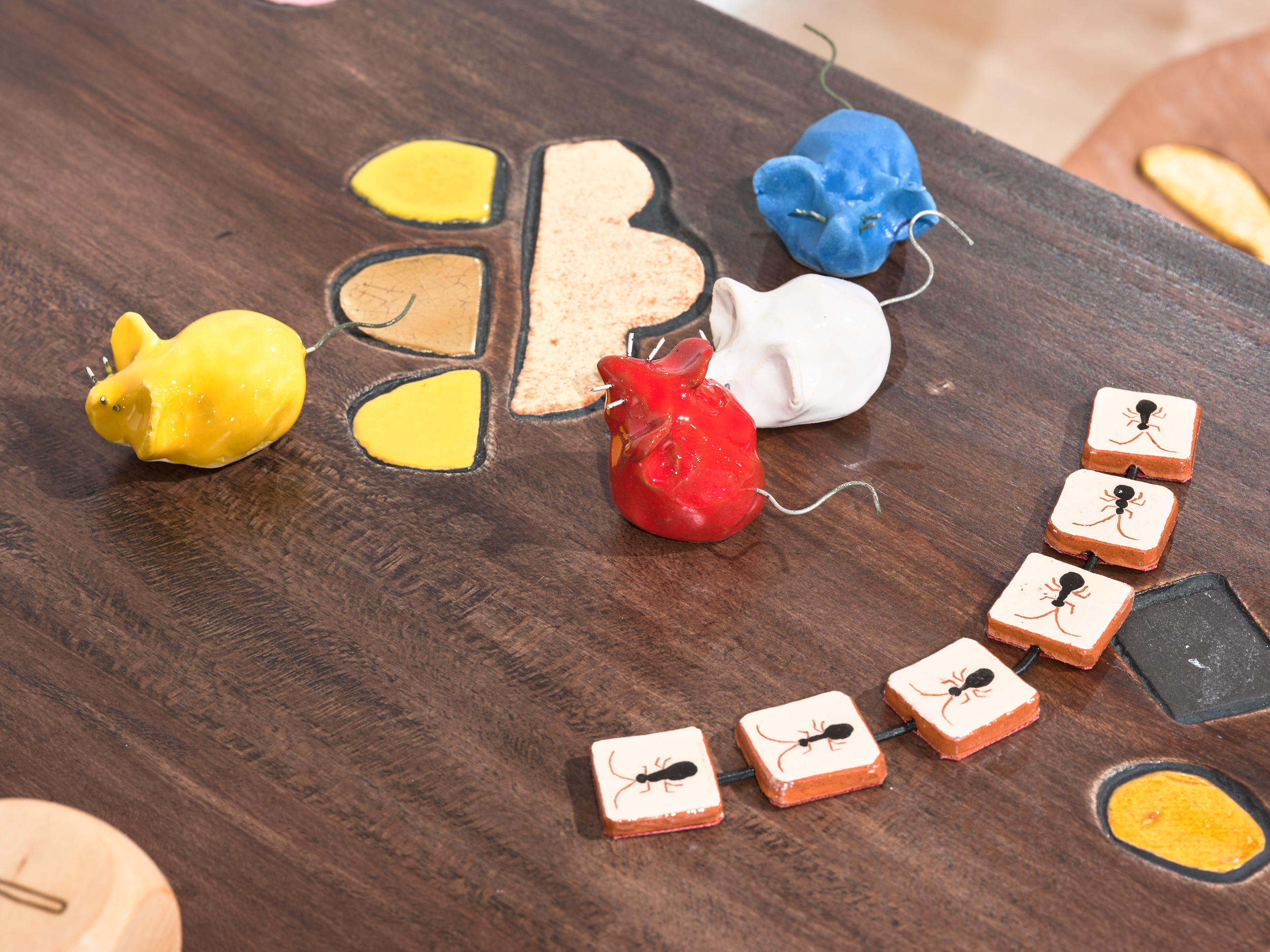
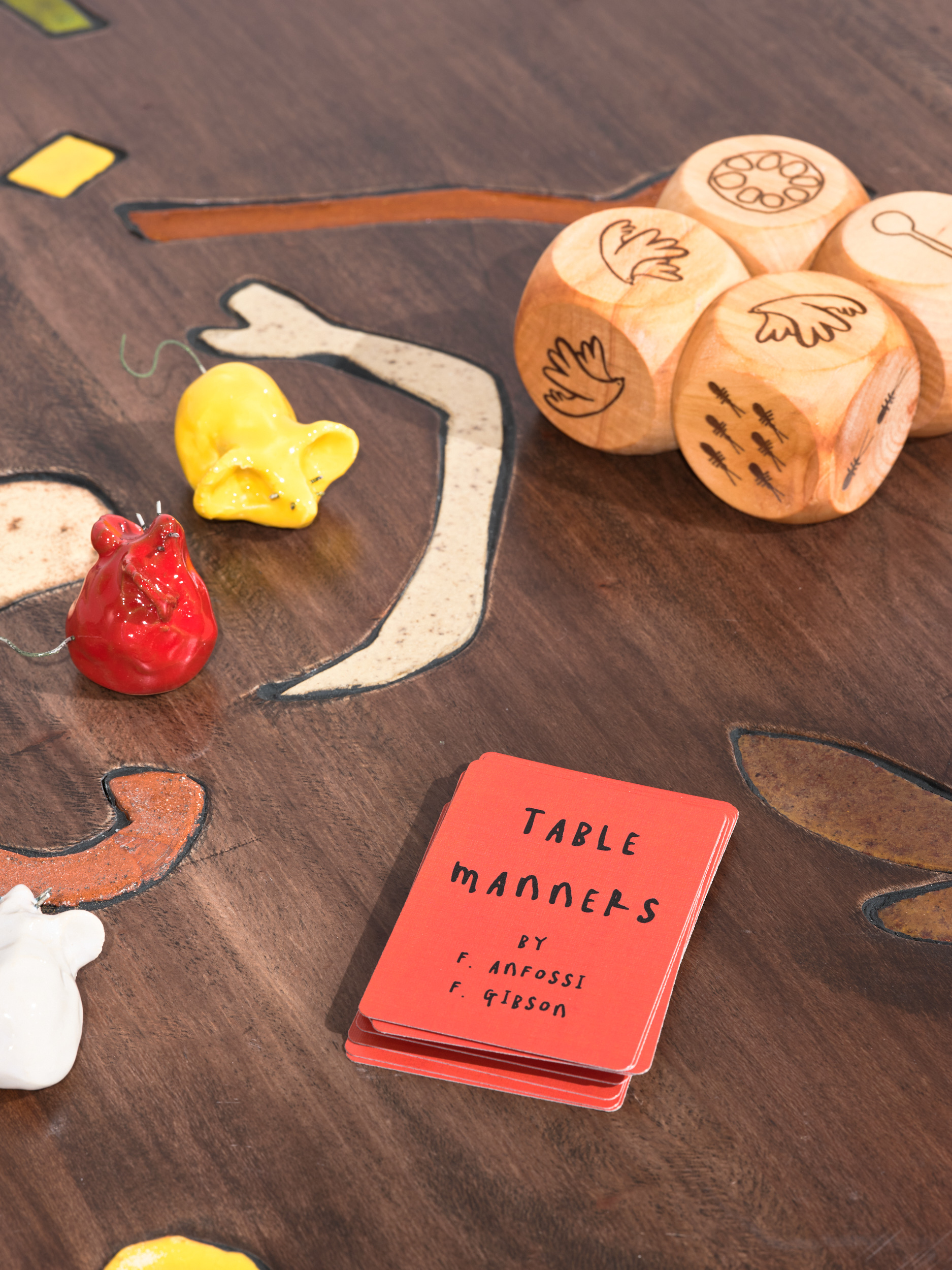
I am presenting two square tables alongside a new series of ceramic stools, each featuring seats made from reclaimed London Plane wood. Inlaid ceramic pieces into the surface of each seat are the footprints and eggs of various bird species—Chicken, Heron, Woodcock, Pigeon, and Crow. The stools are arranged around the two square tables titled The Left Over (2025), which were created using the same technique. The ceramic inlays in the tabletops resemble scraps of leftover food, evoking themes of consumption, domestic ritual, and the traces we leave behind.
I am also exhibiting one or two of my floor lamps, titled Mother (2024), and Gum Lamp, (2025), which has been included to introduce a sense of intimacy and a domestic atmosphere to the playful table setting.
While the work is already designed to invite people to sit around a table, Frances Gibson and I have co-designed and produced a collaborative board game titled Table Manners. Playful and humorous in tone, the game invites participants to use a mouse piece to chase scraps of food across the table—highlighting notions of etiquette, chaos, and shared mealtime dynamics in an imaginative and interactive way.
What are you currently working on? Are there any upcoming projects or exhibitions we should look forward to?
I am currently developing work for an upcoming two-person exhibition at Blunk Space in California, scheduled for 2026. This collaborative project is deeply informed by my time at the JB Blunk Residency, where I lived and worked in the late artist’s home. Immersing myself in the surrounding landscape and engaging with Blunk’s legacy has been a profound source of inspiration. The work I am creating is a direct, responsive dialogue with the environment, the ethos of the space, and the spirit of Blunk’s practice.
The artworks Francesca and Frances have on display are available to purchase in our Collaborative exhibition. To take part in a County Hall Pottery exhibition or to speak to the team, please email gallery@countyhallpottery.com.